
They Hit Us First
The History of American History

I went to high school in the 1980s, which means I received what might generously be called the laminated placemat version of American history.
There were presidents. There were wars. There were maps with arrows. There were brave men making difficult decisions in rooms with flags. There were founding fathers, pioneers, generals, inventors, astronauts, and the occasional carefully selected victim of injustice, introduced just long enough to prove that injustice had been solved by the next chapter.
What there was not, at least not in any meaningful way, was the Jim Crow South.
Not really.
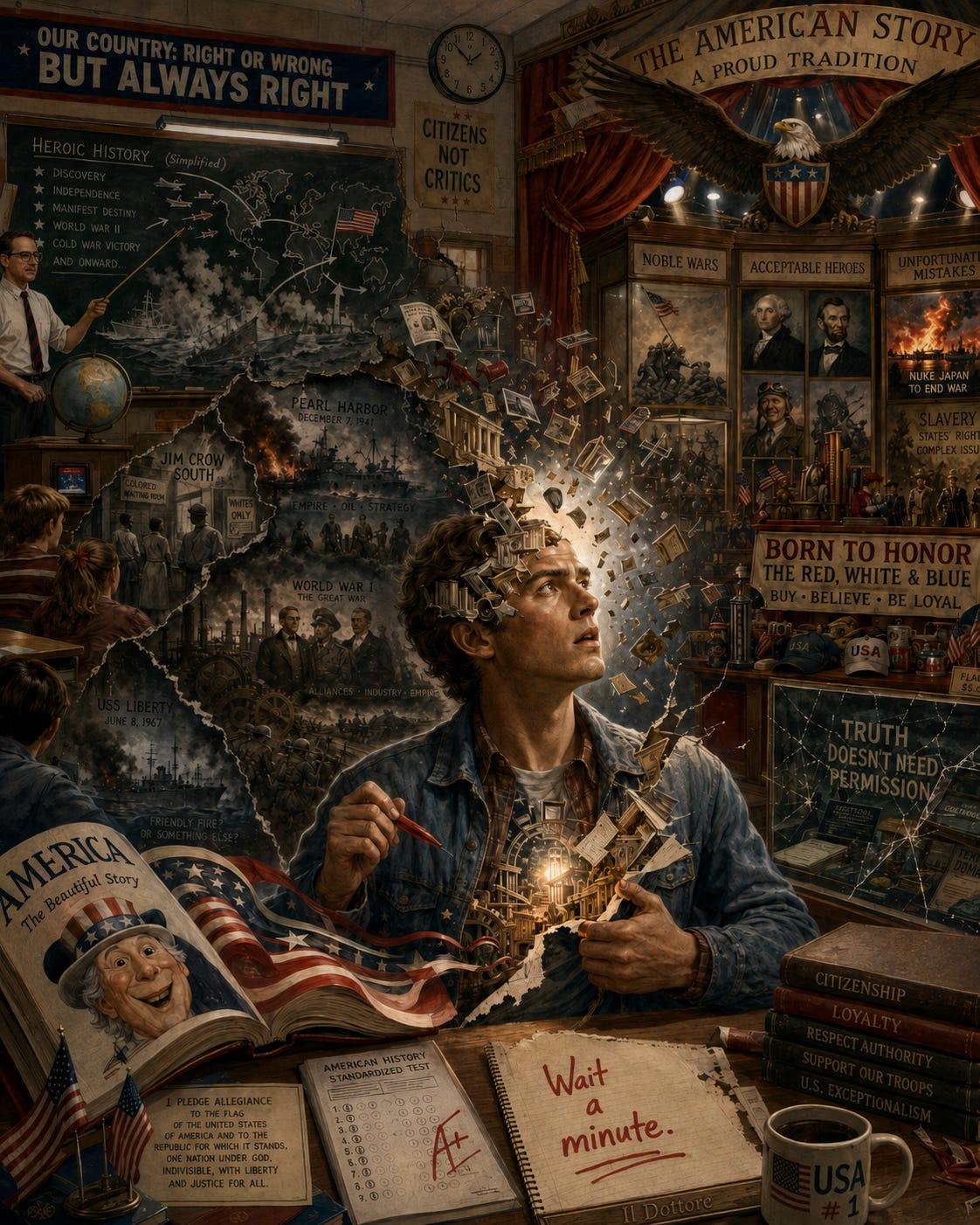
I was not taught, in any deep or sustained sense, that after slavery ended, a large portion of the United States built an entire legal, political, economic, and terrorist system designed to keep Black Americans in a condition as close to slavery as the Thirteenth Amendment would allow. I was not taught the full machinery of it: the poll taxes, the literacy tests, the lynchings, the sundown towns, the segregated schools, the stolen labor, the police violence, the quiet complicity of respectable people who went to church on Sunday and enforced racial caste on Monday.
And perhaps that silence should not surprise me. I grew up in a city with a reputation for white supremacy. So, naturally, the curriculum did what polite systems often do when history becomes embarrassing: it dimmed the lights, changed the subject, and pointed dramatically at George Washington crossing the Delaware.
Nothing to see here, children. Please admire the boat.
The older I get, the more I realize that much of what passed for history education was not education in the fullest sense. It was orientation.
It taught us where to stand. It taught us whom to salute. It taught us which violence was noble. It taught us which victims mattered. It taught us which questions were rude.
And above all, it taught us that America was not merely a country. It was a moral direction. North on the compass. Up on the ladder. Light on the hill. Final answer in the back of the book.
That is not education. That is branding.
I was taught World War II as a moral thunderbolt: Pearl Harbor happened, America woke up, evil was defeated, and everyone bought war bonds. I was not really taught the complicated economic, military, and imperial pressures that preceded Japan’s attack, including America’s embargoes and Japan’s expansionist ambitions in Asia. The lesson was not “history is complicated.” The lesson was “they hit us first.”
Very convenient.
That phrase should be stamped on the front of half the textbooks ever written:
They Hit Us First: An American History.
The same thing happened with the Gulf War. We were told Iraq invaded Kuwait, America assembled a coalition, and righteousness arrived in desert camouflage. I was not taught much about the accusations and arguments involving oil, borders, debt, slant drilling, regional power, or the long imperial chessboard underneath the televised war. I was not invited to ask whether the moral story and the strategic story were the same story.
Because that would have been awkward.
And public education, at least when it comes to national myth, has often treated awkwardness as a form of treason.
Vietnam? That was presented as tragic, yes, but often in foggy language: miscalculation, containment, Cold War anxiety, difficult choices. I do not remember being taught with sufficient force that the Gulf of Tonkin incident, used to justify major escalation, was deeply contested and later understood as far more dubious than the government initially claimed.
Translation: the door to hell may have been opened with a fog machine and a press release.
World War I? We got the assassination of Archduke Franz Ferdinand, a sandwich of alliances, some trenches, some mustaches, and then everyone got influenza. But the deeper madness of it — empires, aristocrats, militarists, industrialists, nationalists, and political elites feeding millions of ordinary people into the meat grinder of Europe — was not emphasized with the moral horror it deserved.
The way it was taught, World War I sounded like a terrible accident caused by one assassination.
As if history simply slipped on a banana peel and landed in a trench.
But wars do not happen because one man is killed. They happen because entire systems are already soaked in gasoline, and someone finally strikes the match. The assassination mattered. Of course it mattered. But it was not the whole cause. It was the spark in a room full of rich men, frightened men, ambitious men, uniformed men, and men who never planned to sleep in the mud themselves.
Then there are the things that did not appear at all.
The USS Liberty attack by Israel in 1967, for example — a deadly attack on an American intelligence ship during the Six-Day War — was not part of the historical furniture of my education. It did not fit neatly into the official emotional architecture. Some events are taught as national wounds. Others are filed quietly in the drawer labeled “complicated,” which often means “please do not bring this up at dinner.”
And that is the pattern.
The facts that strengthen loyalty are framed. The facts that complicate loyalty are footnoted. The facts that threaten loyalty are buried in the basement behind the broken overhead projector.
So now, looking back, I feel something unsettling.
I do not simply feel that I was undereducated.
I feel that I was programmed.
Not in the dramatic science-fiction sense. No one strapped me into a chair, pried my eyes open, and forced me to watch Schoolhouse Rock while a man in a flag tie whispered, “The Senate is your friend.”
It was softer than that.
More elegant.
A little anthem here. A little pledge there. A textbook chapter with the blood removed. A heroic painting. A multiple-choice test. A teacher moving quickly because the district pacing guide says Reconstruction must be covered before Thursday. A school culture that rewards compliance and calls it citizenship.
And over time, a child absorbs the shape of acceptable thought.
You learn that loyalty is maturity. You learn that doubt is cynicism. You learn that criticism is disrespect. You learn that the country is not something to understand but something to believe in.
That is the real trick.
A nation does not have to explicitly tell children, “Do not question us.” It only has to teach history as a sequence of noble intentions interrupted occasionally by unfortunate mistakes.
Slavery? Mistake. Jim Crow? Mistake. Vietnam? Mistake. Iraq? Mistake. Native dispossession? Mistake. Surveillance, coups, propaganda, assassinations, corporate influence, racial terror, labor suppression, imperial adventure?
Mistakes, mistakes, mistakes.
At some point, one begins to wonder whether the machine is broken or functioning exactly as designed.
Now I find myself in the reconstruction stage.
That is the best way I can describe it.
I am not merely learning new information. I am rebuilding the interior architecture of my own loyalty. I am walking through the museum of my mind and discovering that half the exhibits were sponsored by interested parties.
Here is the Hall of Noble Wars. Here is the Gallery of Acceptable Heroes. Here is the Children’s Wing of Sanitized Atrocity. Please exit through the gift shop, where you may purchase a small plastic Constitution made in China.
The difficult part is that I was raised to be loyal. I was raised to be dedicated. I was raised to believe that love of country meant defending the story I had been given.
But perhaps real love is not defending the story.
Perhaps real love is refusing to let the story remain childish.
A child needs heroes. An adult needs truth.
And truth is almost always less tidy than patriotism prefers.
This does not mean replacing one propaganda system with another. That is the danger. Once you discover that the official story was incomplete, there is a temptation to sprint into the arms of the opposite certainty. Everything was a lie. Every event was staged. Every villain was secretly a hero. Every hero was secretly a villain. The textbook was propaganda, so the podcast must be scripture.
That is not reconstruction.
That is just moving from one cult to another, only now the incense smells like paranoia and beef jerky.
The task is harder than that.
The task is to become historically awake without becoming historically unhinged.
It means learning to hold multiple truths at once. America has done magnificent things. America has done monstrous things. Soldiers have acted with courage. Leaders have lied. Citizens have sacrificed nobly. Corporations have profited obscenely. Democracy has expanded freedom. Democracy has also been used to decorate empire. The flag has inspired liberation. The flag has also been used as a tarp to cover bodies.
That is not anti-American.
That is adulthood.
The purpose of social science education should not be to manufacture loyalty. It should be to develop judgment. It should teach students how power speaks, how nations mythologize themselves, how governments justify violence, how race and class shape memory, how ordinary people become instruments of systems they do not fully understand.
It should teach students to ask:
Who benefits from this version of the story? Who is missing? What words are being used to soften violence? What evidence is being ignored? What would this event look like from the other side? Why was I taught this and not that?
Those are not dangerous questions.
Those are democratic questions.
A republic that cannot survive its citizens asking better questions is not a republic. It is a stage set with a bald eagle painted on the curtain.
So yes, I feel programmed. I think many of us were. Not because every teacher was malicious. Most were not. Many were kind, hardworking, underpaid, and trapped inside systems they did not design. The propaganda was not always personal. It was curricular. Institutional. Atmospheric. It was in the water.
But once you notice the water, you cannot unnotice it.
And that is where reconstruction begins.
Not in bitterness. Not in self-hatred. Not in the adolescent thrill of declaring everything fake.
But in the deeper, stranger, more demanding work of becoming free inside your own mind.
To reconstruct yourself after patriotic programming is to learn that loyalty without truth is obedience. It is to understand that reverence can become anesthesia. It is to realize that a country worth loving must be strong enough to be examined without makeup.
History, properly taught, should not be a loyalty oath.
It should be a crime scene, a family album, a confession booth, a courtroom, a mirror, and occasionally, yes, a circus — because human beings are ridiculous, empires are vain, and every generation seems convinced that its propaganda is just “common sense” with better lighting.
I do not want children indoctrinated into hating their country.
I also do not want them indoctrinated into worshiping it.
I want them educated well enough to recognize when someone is selling them a myth in the costume of a lesson.
Because the final goal of history should not be patriotism.
It should be consciousness.
And once consciousness begins, the old programming starts to glitch.
The anthem still plays. The flag still waves. The textbook still smiles.
But somewhere inside, a new voice appears.
Calm. Clear. A little irritated. Possibly holding a red pen.
And it says:
Wait a minute.
That is the beginning of freedom.