
Planetary Stewardship
(For a Species with a God Complex)

Part 3: So What Should Replace This Mess?
Here is my proposal.
The future should not be built on pure majority rule. It should not be built on pure technocracy either. It should be built on layered planetary stewardship.
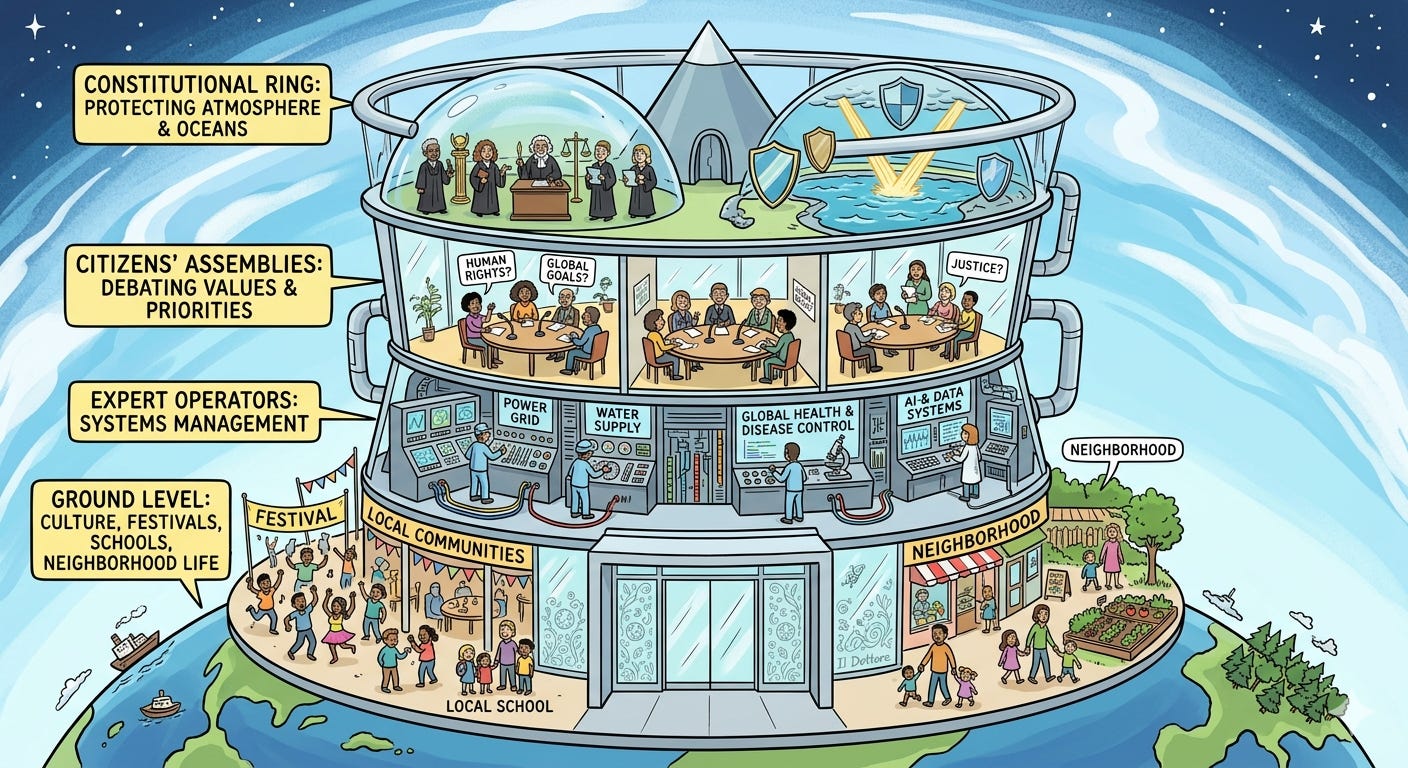
That phrase sounds fancy, but the idea is straightforward: different levels of reality require different levels of governance.
Local matters should stay local. Your culture, language, neighborhood character, schools, traditions, art, food, religion, and strange regional obsessions do not need to be managed by a giant global bureaucracy with laminated badges and dead eyes. Human beings need belonging. Nobody wants to live inside a planet-wide airport terminal.
But planetary matters need planetary governance.
That means certain domains can no longer be treated as the private hobbyhorses of sovereign states. No country should get to torch the climate, poison shared waters, hide pandemics, gamble recklessly with civilization-scale technologies, or destabilize global systems and then say, “Mind your business.” It is our business once it hits our lungs, food, water, or survival.
So here is the structure.
First, a planetary constitutional layer.
There should be a global charter of hard limits: protections against mass atrocity, baseline human survival guarantees, scientific transparency in globally dangerous matters, ecological red lines, and rules around catastrophic-risk technologies and shared commons. In other words, some things should be above national whim. Because adulthood means admitting that sovereignty cannot include the right to wreck the ship.
Second, a democratic layer.
People should still decide broad values and moral direction. What do we owe one another? What rights matter? What kind of future is worth building? What tradeoffs are acceptable? These are human questions, not engineering equations. Democracy should live here.
But democracy should also get better. Less circus, more deliberation. Less panic, more learning. Citizens’ assemblies chosen by lot could help. Frankly, a randomly selected room of people with time to learn the facts might outperform half the professional political class by lunchtime.
Third, a technical layer.
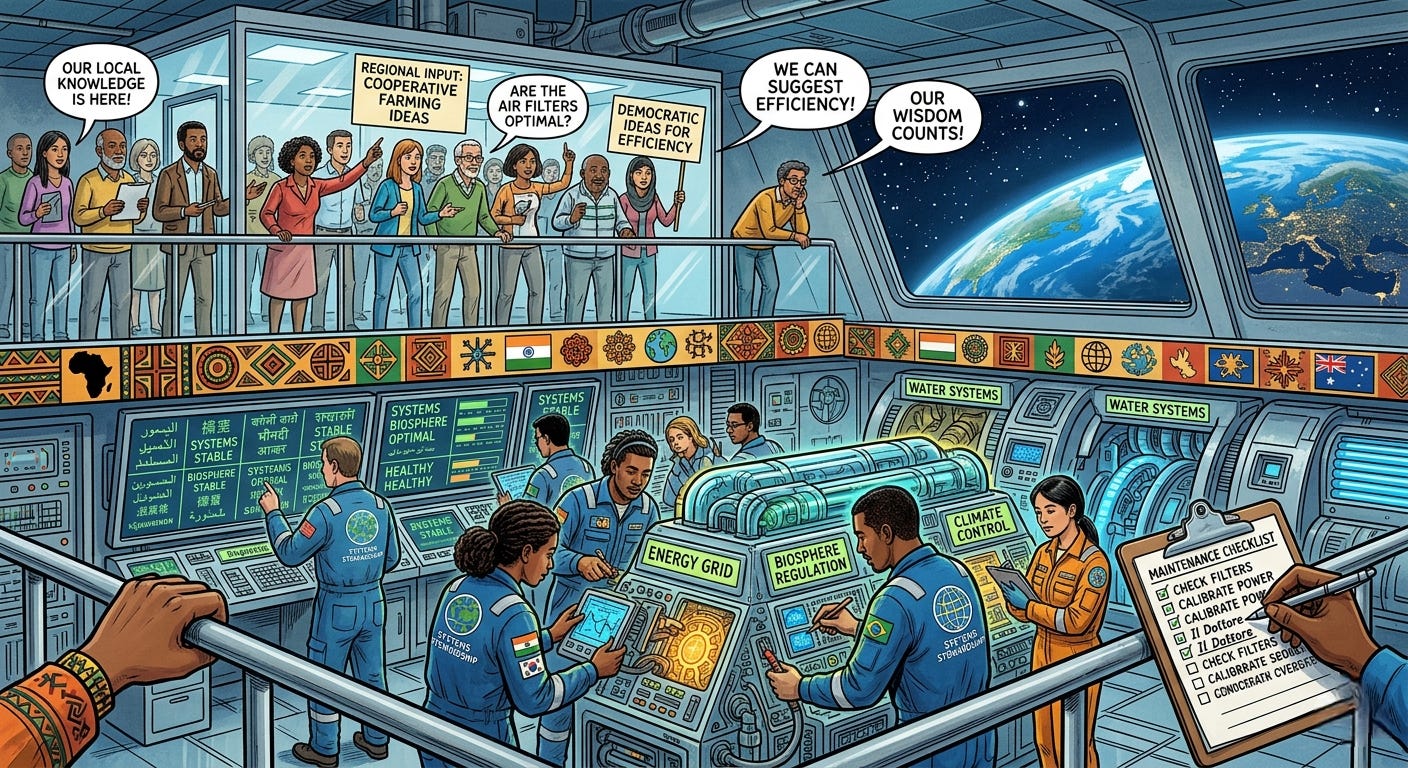
Complex systems should be run by competent institutions with narrow mandates, hard metrics, transparency, outside review, and legal constraints. Energy systems by people who understand grids. Water by people who understand water. Biosecurity by people who understand outbreaks. AI oversight by people who actually know what the machines do, instead of people who still think “the cloud” is a weather event.
This is not because experts are saints. Many of them have the charisma of expired yogurt. But bridges, viruses, drought, and semiconductors do not care about your political identity. Reality is not taking a poll.
Fourth, a subsidiarity layer.
Anything that does not need to be governed globally should not be. Push power downward whenever the problem allows it. This keeps the system human and reduces the risk of a giant managerial blob deciding everyone’s curtains should be gray.
Fifth, an anti-capture layer.
This is non-negotiable. Any system this ambitious could become corrupt, remote, and insufferably smug. So it needs audits, transparency, rotating oversight, independent review, multiple competing expert centers, legal firebreaks, whistleblower protections, term limits in critical roles, and real civic scrutiny. Otherwise you do not get stewardship. You get empire with PowerPoint.
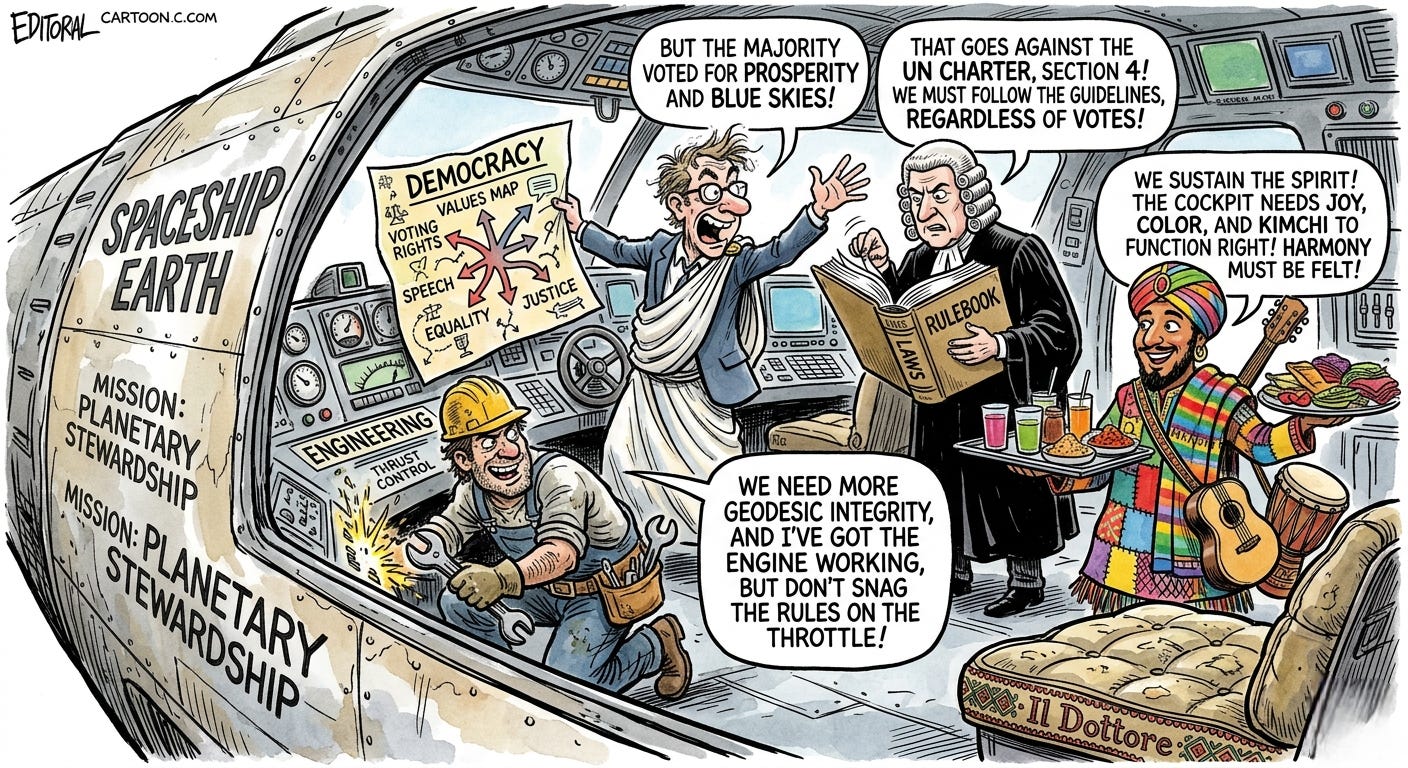
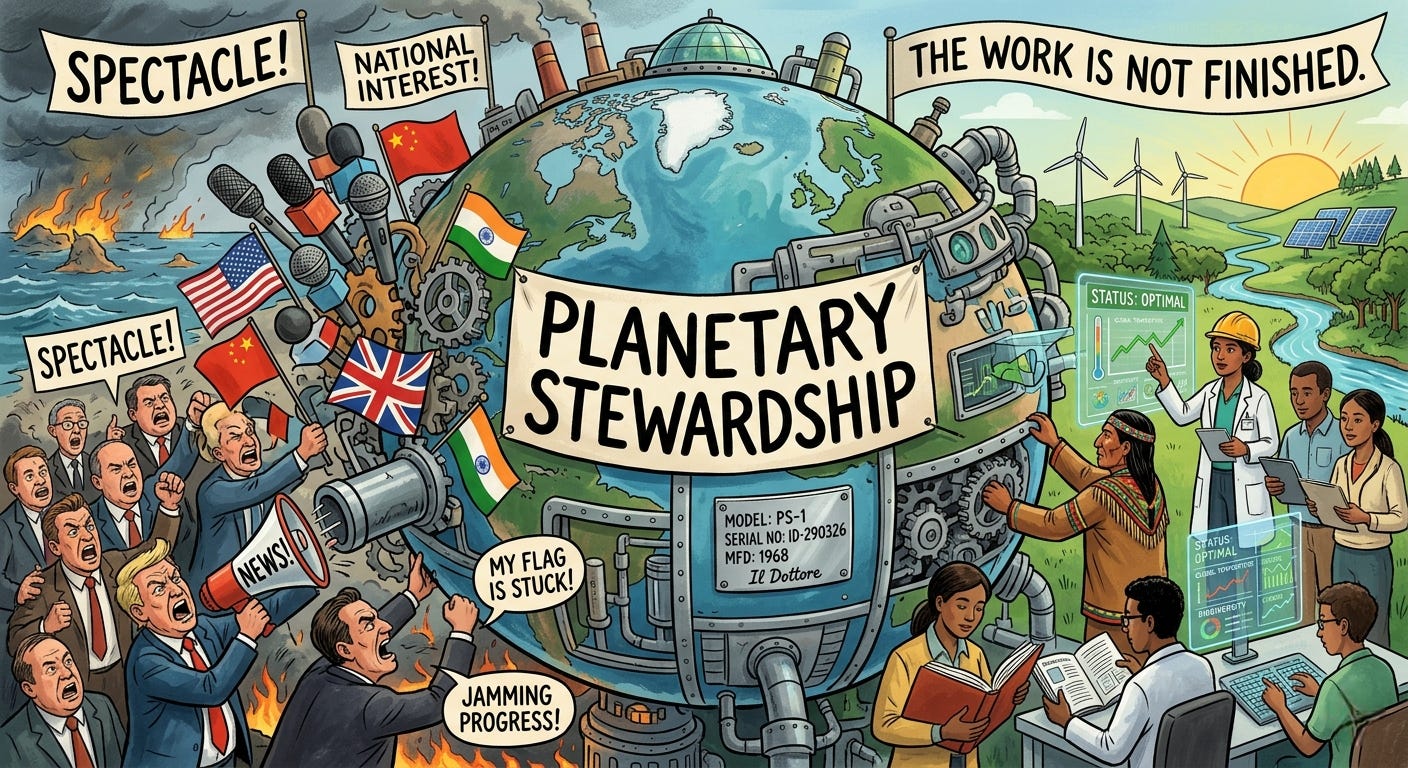
That, to me, is the future: democracy sets values, law sets limits, expertise manages systems, local communities keep their texture, and planetary institutions handle what is actually planetary.
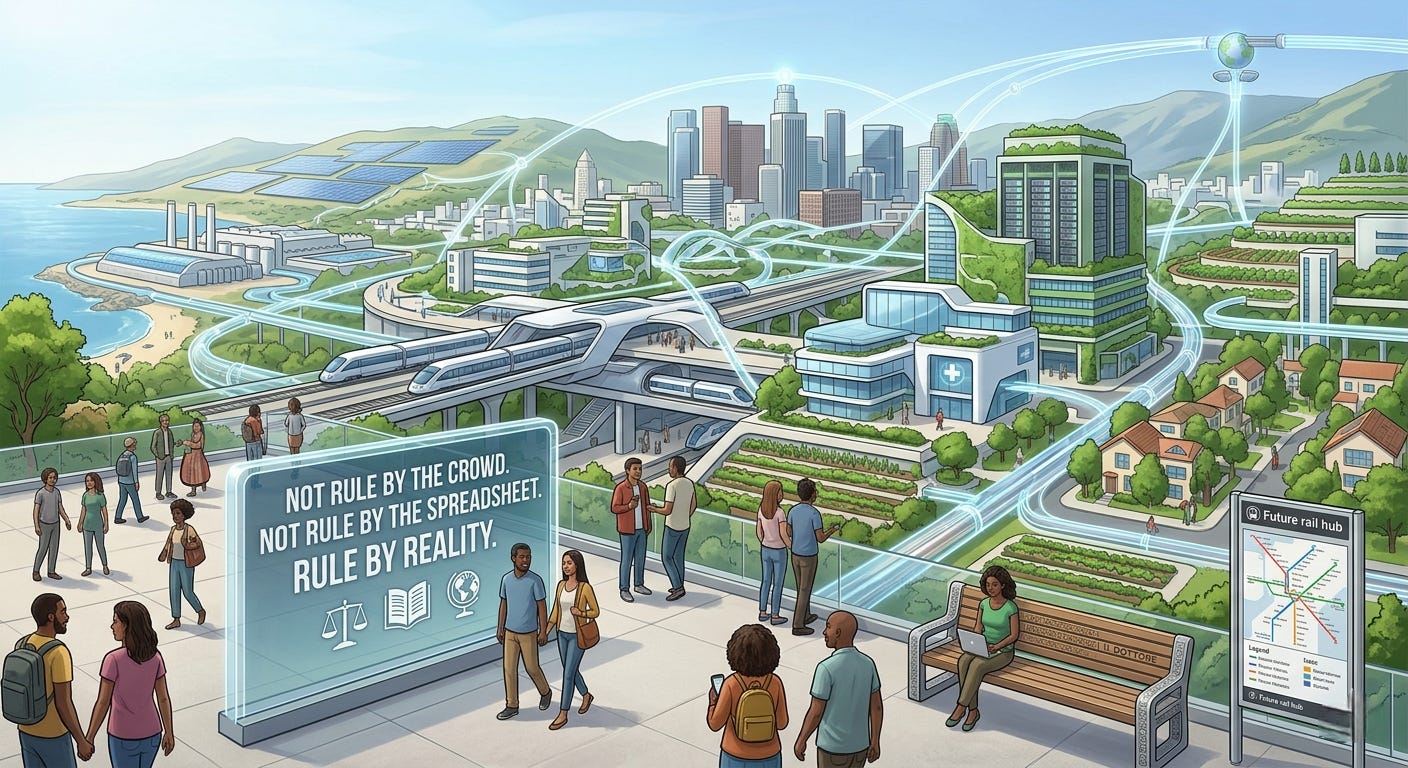
Not rule by the crowd. Not rule by the spreadsheet. Rule by reality, with supervision.
And that brings me back to The Wisdom of Crowds.
Yes, the crowd has wisdom. Yes, ordinary people know things institutions miss. Yes, distributed intelligence is real.
Good. Use it.
Listen broadly. Gather information widely. Let the public help identify needs, set priorities, and challenge insulated elites.
But stop pretending that because the crowd can sometimes guess well, it should directly operate the engine room of Spaceship Earth.
The crowd may know the ship is listing. Excellent. We should listen.
But somebody still has to know how to fix the damn engine.